Five Prerequisites Before You Start Vibe Coding
What Is Vibe Coding (Really)?
“Vibe coding” usually means building software quickly with the help of AI tools — focusing on momentum, experimentation, and rapid feedback instead of heavy upfront design.
That speed is powerful.
But without the right foundations, vibe coding often leads to:
- insecure systems
- unmaintainable code
- fragile deployments
- painful rewrites later
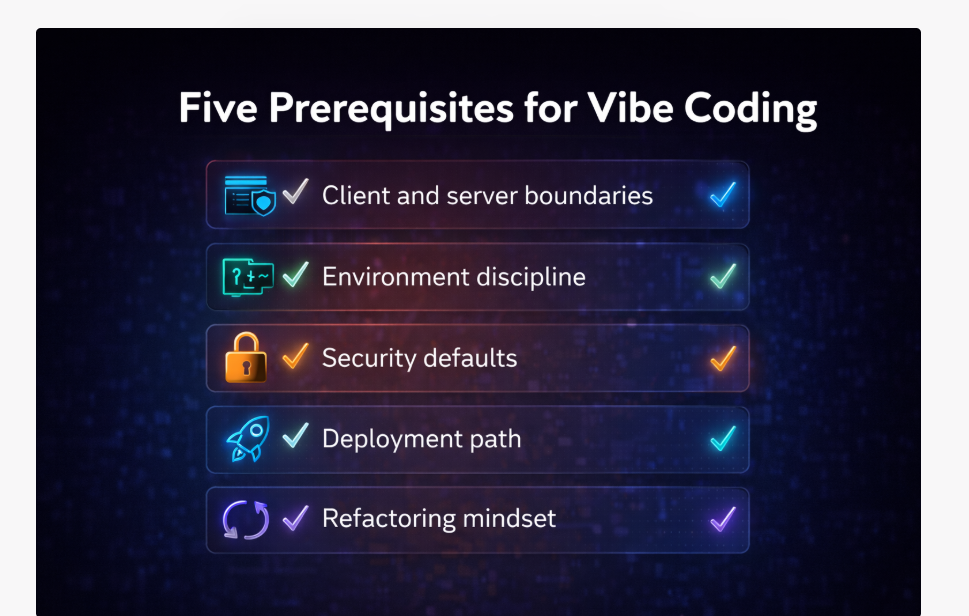
Before leaning into AI-assisted development, these are five prerequisites I make sure are in place.
1. Clear Boundaries Between Client and Server
Before writing a single prompt, you should know:
- what runs in the browser
- what must stay on the server
- where secrets live
If you don’t have clear client/server boundaries, AI-generated code will almost always leak logic or secrets in the wrong place.
Rule of thumb:
If it talks to credentials, infrastructure, automation, or billing — it belongs on the server.
2. Environment Discipline (Dev ≠ Prod)
Vibe coding works best when environments are predictable.
Before starting:
- define dev and prod clearly
- separate environment variables
- ensure prod secrets never exist locally
If everything runs in “one environment,” AI will happily generate shortcuts that break the moment you deploy.
3. Basic Security Defaults
You don’t need enterprise security on day one — but you do need defaults.
At minimum:
- no secrets in the frontend
- server-side validation
- authentication before protected routes
- least-privilege access
AI tools accelerate development, but they don’t automatically enforce security unless you already care about it.
4. A Simple Deployment Path
Before vibe coding features, you should be able to answer:
- How does this get deployed?
- How do I roll it back?
- How do I destroy and recreate it?
If deployment is unclear, fast iteration just creates fast chaos.
A boring, repeatable deployment pipeline beats clever scripts every time.
5. A Willingness to Refactor
Vibe coding assumes one thing: you will rewrite parts of the system.
If you’re not willing to:
- delete code
- refactor aggressively
- simplify early decisions
then AI-generated velocity will hurt more than it helps.
Speed without refactoring discipline is just technical debt in disguise.
Final Thoughts
Vibe coding is not the problem.
Starting without foundations is.
When you combine:
- clear boundaries
- environment discipline
- security basics
- repeatable deployments
- refactoring mindset
AI becomes a powerful accelerator — not a liability.
Move fast, but move intentionally.